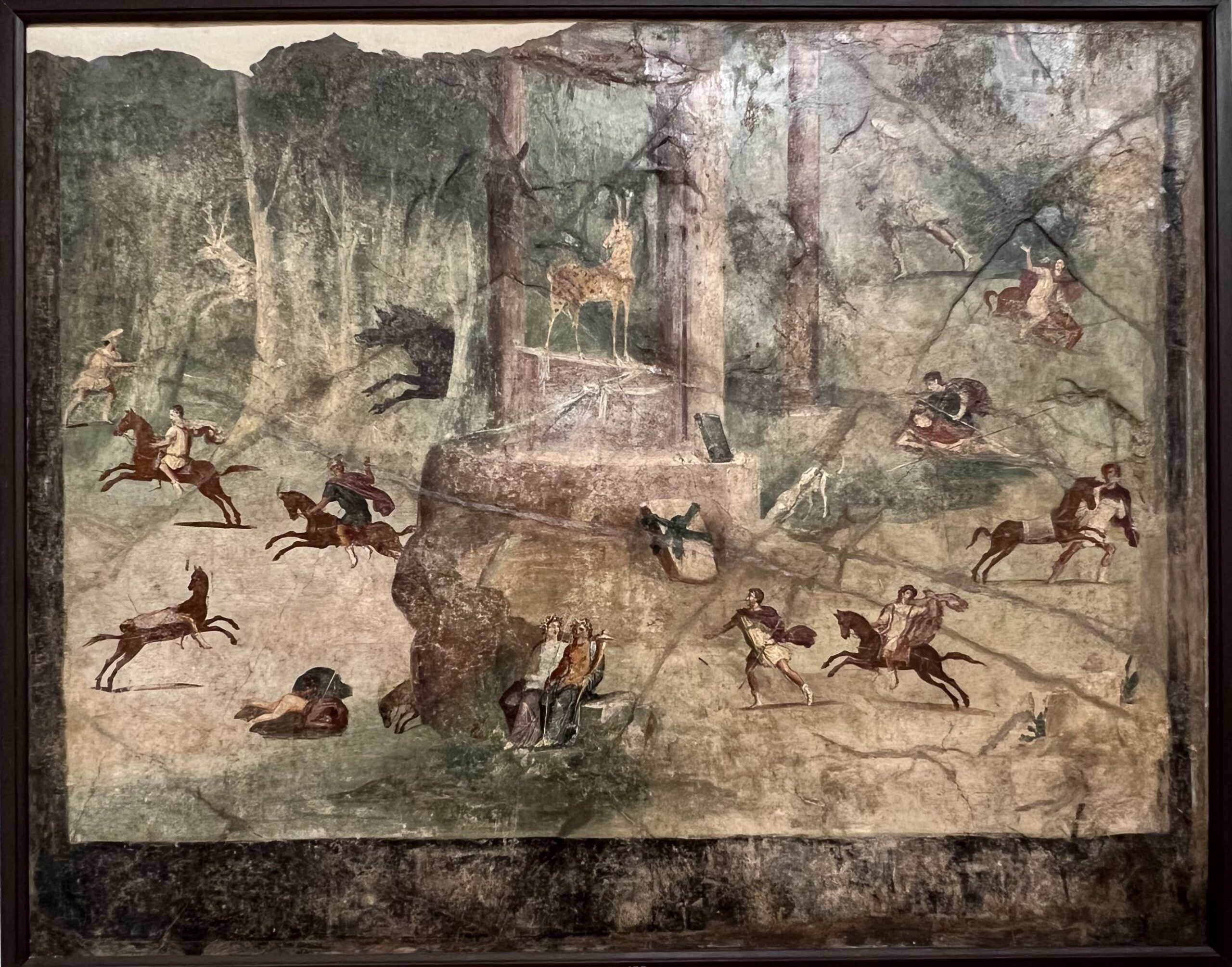
Fresco from the House of the Sailor, Pompeii, 1st century b.C. – 1st century A.D. Museo Archeologico Nazionale di Napoli
Notes on the MANN and Pompeian painting
Among the items preserved at the National Archaeological Museum of Naples that have no equal in the world is undoubtedly the painting collection, the Pompeian frescoes, which peremptorily contains the crux of all developments in painting for the following two thousand years. Actually, paradoxically, it contains all possible painting.
The most refined observers will say that it is our contemporary eyes that find their own traces in antiquity, whereby a thing emerges into consciousness when it is already called upon. But there is no harm in stating the exact opposite: in the extreme depth of antiquity, our sensibility rediscovers the origin of things, which is ultimately the origin of humanity. And this is why this painting evokes continuous unsolicited resonances, especially those belonging to different cultures.
Take, for example, the mural painting with horses and hunting scenes from the House of the Sailor, and let us observe it closely. The sight of this work brought me directly back to a fragment of a Tang era fresco that I saw in Xi’an, from the funerary decorations of the imperial tombs in Shaanxi. Two worlds that never spoke to one another, two civilizations that developed radically incompatible visual systems, yet united by a detail that is not a mere detail: the galloping horse. In both frescoes, the horses run with their four legs simultaneously extended, the front ones projected forward, the hind ones pushed backward, the body suspended in an air that does not exist.
It is the universal pictorial convention of the flying gallop, universal because no pictorially mature civilization has been able or willing to represent the equine gallop in its biomechanical truth. Only in 1878 would we know scientifically, through the experiments conducted by Eadweard Muybridge, that the gallop occurs differently, but that does not matter.
Here lies the paradox that interests me: the Pompeian painter, formed in a culture that had taken pictorial illusionism to heights that the West would not reach again for fifteen centuries, and the Tang painter, formed in a calligraphic tradition of extraordinary precision of line, make the same “mistake”. Both paint not what they see but what they know about the gallop, or rather what the gallop produces in perception: the sensation of absolute speed, of a body launched beyond its own limits, of energy exploding in space. The flying gallop is not an oversight; it is a cognitive synthesis, the visual translation of a kinetic emotion that the eye registers but that the brain reworks and amplifies. It is, strictly speaking, truer than true.
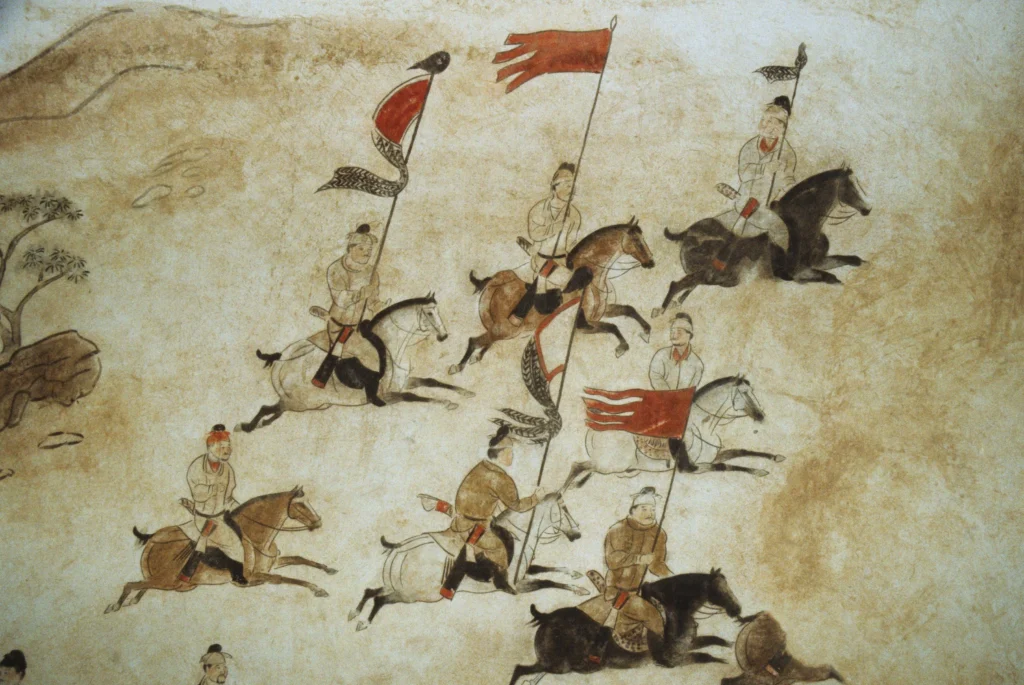
Fresco from the Qianling Mausoleum, Tang dynasty (618 – 907 d.C)
Returning to the MANN and to the fresco, what it contains of the programmatically untimely is interesting. Pompeian painting, and herein lies its absolute superiority as a document of the history of human perception, is never mimetic in a banal sense. It is always, even in its apparently decorative outcomes, a theory of vision. When the painters of the Vesuvian domus construct the illusionistic space of a sacred forest, when they modulate depth through the chromatic degradation of greens, when they make cloaks twirl and bodies vibrate in the instant of the hunt, they are not copying reality: they are elaborating a system of perceptual equivalences that anticipates, with an ease that still astounds today, questions that European painting would officially open only with Impressionism.
The impossible galloping horse is the most eloquent proof: not a limit of ancient knowledge, but the sign of an extremely high perceptual awareness, which knows that art does not give the world but its echo in the mind of the observer. And this is exactly why that painting continues to speak to eyes that do not belong to its civilization, to resonate without being prompted, to establish short circuits with a Tang painter who never saw Mount Vesuvius and with a contemporary observer who never lived in the Roman Empire. The origin of things, as we were saying. It is right here.
But there is a further level that the iconographic subject imposes and which must not be evaded. The fresco of the House of the Sailor does not represent just any hunting scene. It is a scene of the Niobids. Apollo and Artemis exterminating the children of Niobe, guilty of having placed her own offspring before the divine offspring. The doe that appears in the fresco is not a hunted animal: it is the sacred animal of Artemis, its presence in the painting is a signature, a seal. The horses galloping with their legs outstretched in the non-existent air do not carry hunters. They carry gods on a punitive mission.
This changes everything. Or rather: it clarifies everything. The impossible gallop is not only a cognitive synthesis of speed. It is the speed of the sacred, of time collapsing when the divine intervenes in the mortal. The gods do not move according to the laws of biomechanics. The Pompeian painter knows this. He paints a gallop that does not exist because what he represents does not belong to the order of the visible.
The convention of the flying gallop is, in this context, a theological solution even before a perceptual one. It depicts the unrepresentable—the speed of divine punishment, the instant in which time is suspended and fate is already decided—through a body that defies the laws of the body.
And here the convergence with the Tang fresco ceases to be a comparative curiosity and becomes a more serious matter. The Tang horsemen in the imperial tombs of Shaanxi are not marching soldiers. They are the escort of the deceased emperor on his journey to the afterlife. There too, the gallop is cosmological, not military. There too, the horses run in an air that does not exist because the world they traverse is not this world.
The visual convention is identical. The mandate is identical. Two painters, two cosmologies, a single impossible gallop—because in both cases it is a matter of representing the movement of that which physical movement cannot contain. This too, at the MANN, can be understood without anyone explaining it.
– Arch. Gaetano di Gesu